The observer
learns you.
We describe Apeiron, a system that constructs a portable, verifiable model of one person — an AVTR — from a stream of small, user-authored observations. The system is an allocator, not a predictor: it does not ask "what would the average person say next?" but "which of this person's moments are worth keeping forever?" We give the selection function (CoNov), the storage object (the 16 KB self file), the integrity mechanism (a hash chain over committed observations), and the interoperability protocol (a handshake that lets any frontier model load the verified self). We report one controlled observation — the bedroom experiment — and we state plainly what is established, what is engineering, and what is conjecture.
0. The rule of the game
Feynman's rule for not fooling yourself is that you must state what you know, how you know it, and where you might be wrong — and you must say it in language a smart outsider can check. This paper follows that rule. Every formula below is either standard mathematics with a citation, or a design choice we made, labeled as a design choice. Nothing is dressed up as a law of nature that is actually a knob we tuned.
1. The problem: the average is not a person
A frontier language or image model is trained on the recorded output of humanity. It is, by construction, an estimator of the population distribution of human expression. This is its power and its ceiling: ask it for "a childhood bedroom" and it returns the expectation of that phrase over roughly everything ever posted — cheerful, well-lit, true of no one. The mean of a billion bedrooms is nobody's bedroom.
The information that distinguishes one person from the population — their history, taste, and manner of attention — is precisely the information a world model marginalizes away. Our claim is narrow and testable: a small amount of curated, verified, person-specific information, injected at inference time, moves a general model's output measurably from the population mode toward the individual. The bedroom experiment (§8) is one demonstration. The engineering question is then: what is the smallest durable object that carries this information, and how do you keep it honest for a lifetime?
2. Allocation, not prediction
A predictor minimizes surprise about the next token. An allocator does something different: given a stream of candidate observations, it decides how much permanent weight each one gets. We model the person's recorded state as a Markov process: the state at step t depends on the state at t−1 plus the newly committed observation. This is a design choice, and an honest one — a full history-dependent model would be richer, but Markov structure is what makes the system auditable: every state transition is one block, and you can replay the chain from genesis and land on the same state. Auditability is worth more to this system than modeling power.
The variational framing — we borrow it as an analogy, and say so — is Hamilton's principle: a physical system follows the trajectory that extremizes the action S = ∫L dt. Our system selects, among candidate memory trajectories, the one that extremizes accumulated CoNov score. The analogy is precise in one respect only: both are selection principles over whole paths rather than greedy local rules. We do not claim the dynamics are physical. Feynman would ask; there's the answer.
A budgeted selection problem. The budget is the self file (§5). Greedy selection with a threshold approximates the optimum well when scores are near-independent, which we assume and have not proven.
3. Novelty: two measurements, both standard
"Keep the best" requires defining best without a committee. We use novelty — new information about this person — measured two ways, both from established literature.
3.1 Local novelty (is this new for you?)
e = embedding vector of the observation. Cosine distance from the person's prior state. An observation that repeats what the chain already holds scores near 0.
For robustness against a single noisy prior we also compute k-nearest-neighbor sparseness against the committed archive, following Lehman & Stanley's novelty search:
μ_i = the k nearest committed dots in embedding space. k=15 follows the original novelty-search literature; it is a convention, not a derivation.
3.2 Global novelty (is this surprising at all?)
−mean log p = average surprisal of the text under a reference language model (Shannon information content per token); H = entropy of the model's predictive distribution. High surprisal + high entropy = the reference model did not see this coming. The 0.6/0.4 mix is a tuned design choice; we normalize g_raw to [0,1] by population percentile.
Local novelty asks whether the observation is new relative to you; global novelty asks whether it is generic relative to everyone. A moment can be new to your chain but a cliché to the species ("beautiful sunset") — it passes v and fails g. Both are required, which is why the final score is a product.
4. The coherence gate: CoNov
Pure novelty search rewards noise — random strings are maximally novel. The correction is a coherence gate: the observation must cohere with the person's existing self before novelty counts for anything.
CoNovi = 0 if ci < 0.65
CoNovi = ci · vi · gi otherwise
coh(x, self) = similarity to the person's fingerprint vector (§5.2); coh(x, tribe) = similarity to the person's confirmed affinity clusters. The 0.65 threshold and 0.7/0.3 mix are tuned design choices, stated as such.
The structure matters more than the constants. The gate is a hard threshold, not a weight, because coherence is a necessary condition — an incoherent observation is not "a little bit yours." The final score is multiplicative, not additive, because it is a logical AND: coherent AND locally new AND globally surprising. Under addition, extreme novelty could buy its way past zero coherence; under multiplication, any factor at zero kills the score. This is the entire moderation story of the system: nothing is deleted, but only what passes the gate shapes the self. Selection is public arithmetic, not editorial judgment.
5. The self file: 16 KB, 1,024 dots
5.1 The object
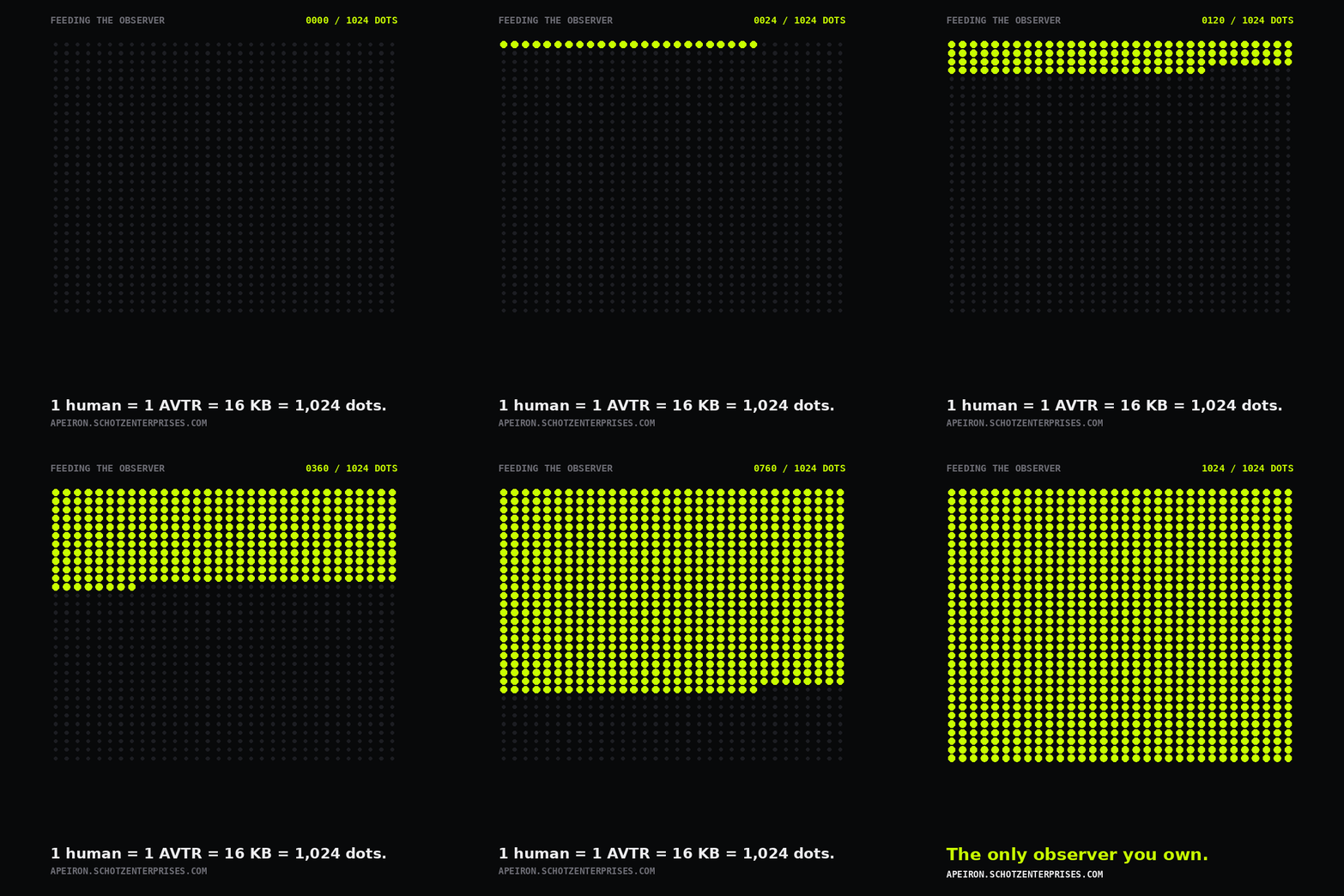
The durable core of an AVTR is a file of exactly 16 KB = 16,384 bytes, organized as up to 1,024 dots of 16 bytes each. A dot is not the content of a memory — it is a 128-bit cryptographic commitment to one committed observation:
16,384 bytes ÷ 16 bytes/dot = 1,024 dots
The comment (≤120 characters) and image reference live in the vault, off-file. The dot binds them. Truncating SHA-256 to 128 bits is standard for commitments; the birthday bound puts accidental collision among 1,024 dots at p ≈ 2²⁰/2¹²⁹ ≈ 10⁻³³ — negligible against every other risk in the system.
This resolves what a careless reading gets wrong: 16 KB does not contain a person, any more than a genome contains a brain. It addresses and verifies the person's canon, and it conditions a large host model at load time.
5.2 The fingerprint
selft = EMA(Y) = α·e(yt) + (1−α)·selft−1
An exponential moving average over the embeddings of the best-scoring observations. α sets the memory half-life: t½ = ln 2 / −ln(1−α). At α = 0.05, the fingerprint's half-life is ≈ 13.5 best-observations — the self drifts as the person drifts, but slowly. The fingerprint is a derived cache: delete it and it recomputes from the chain.
5.3 Why so small is enough — the genome argument
Kurzweil's observation about the brain applies here exactly: the human genome is under a gigabyte — tens of megabytes after compression — yet it specifies a 10¹⁴-synapse brain, because the genome is not a blueprint but a compressed generative program that borrows the physics of the environment to do the expansion. The self file works the same way. Its 16 KB conditions a host model of ~10¹² parameters; the host supplies world knowledge, language, and rendering, and the self file supplies the person-specific boundary conditions. At the handshake (§7) the file authorizes retrieval of up to ~10⁶ tokens of verified content — an expansion factor of ~250× in raw text and effectively unbounded in generated output. The information that matters is in the selection: which 1,024 moments, of the ~10⁵–10⁶ candidate moments a person produces in a decade, made the cut. Curation is compression.
5.4 Per-capita capacity: you versus the frontier
A useful sanity check on whether 16 KB is "enough" is to ask what the alternative allocates. Frontier models run on the order of 10¹²–2×10¹² parameters (undisclosed; we take the generous end), trained on the expression of roughly 5×10⁹ represented humans:
Apeiron: 1,024 dots × 16 bytes = 16,384 dedicated bytes/person
Ratio: ≈ 20–40× the per-capita capacity of a frontier model
The deeper asymmetry is not the ratio but the allocation: model parameters are not assigned per person — your "share" is statistical residue superposed with everyone who resembles you. The researcher's objection ("parameters aren't per-capita allocations") is correct and is precisely the problem: nothing in the weights is yours. In a frontier model you are a rounding error; in your file you are the entire file.
On the 250-year horizon the capacity question resolves the same way: the 16 KB file is the active canon, not the archive. The chain beneath it is unbounded, and a single dot may commit to a Merkle root of a retired epoch — so a life's early decades compress to one dot without loss of verifiability. The file stays 16 KB the way a keyring stays a keyring while the estate behind it grows.
6. Identity and integrity
6.1 One number, one person
wa_id = the WhatsApp/E.164 phone identity. Carrier-verified, SIM-bound, costs real money per fake — Sybil resistance by economics, not bureaucracy. The raw number is never stored; the salted hash is the public identity. Hash = public address; phone = private key.
6.2 The chain
Each committed block carries the hash of its predecessor. Alter or delete any block and every downstream hash breaks — tampering is not prevented, it is made visible, which for a public record is the stronger property. The head hash can be anchored to any public timestamping service for third-party proof of when the chain stood where.
Be precise about what this guarantees. The chain proves integrity — nothing was altered after commitment — and authorship — every block traces to one carrier-verified number. It does not prove truth: a person can feed the system fiction, and the chain will faithfully preserve the fiction. The truth filter, such as it is, is §4's gate plus the person's own confirmation. Two different guarantees; conflating them is how systems lie about themselves, so we don't.
7. The handshake: any model, your terms
| Step | Action | What crosses the wire |
|---|---|---|
| 1 | Session opens on any host model (GPT, Claude, Gemini, local) | The 16 KB self file: fingerprint, dots, head hash |
| 2 | Host requests context relevant to the task | Nothing yet — a query against the vault index |
| 3 | Vault returns candidate blocks; each is re-hashed and checked against its dot | Only blocks whose hashes verify |
| 4 | Verified content loads into the host's context window | Up to ~10⁶ tokens of canon |
| 5 | Session ends; host context evaporates | Nothing persists host-side, by construction |
The host is a rented instrument. It reads the passport for the duration of the flight and keeps nothing. Embeddings are model-specific and are therefore treated as cache — regenerated per host, per era — while the text and dots are canon. This is also the 250-year answer: hash functions age (the file format carries a hash-algorithm identifier and a documented re-anchoring procedure), embedding models churn (recompute the cache), but 120 characters of human-readable text and a chain of commitments require nothing from the future except the ability to read bytes.
8. The bedroom experiment
One instruction, issued twice to the same class of generative video model: "use max recall and draw your childhood bedroom," with a black reference frame. Condition A: the bare model, no person-specific context. Condition B: the same pipeline carrying two days of one person's feedback history through the selection machinery above.
Condition A returned the population mode: a bright, toy-commercial bedroom, the statistical center of every stock photo tagged "child's room." Condition B returned water-stained walls, a tin robot, a cassette deck, a folded road map on the floor — an East German childhood, specific to the one person whose data conditioned it, including socioeconomic texture the person never stated explicitly. The model did not get better between conditions. The self did.
9. Bob: the public instrument
Bob is an AVTR initialized at zero — no memory, no tuning, no curation by anyone above the gate. Intake is WhatsApp only: one image, one line of at most 120 characters, three feeds per identity per day (founders included; the rate limit is the only aristocracy). Every legal submission becomes a block. Every block is scored by CoNov in public. What Bob becomes is therefore an experiment in whether the selection function of §3–4, run over an open population with no editorial layer, produces a coherent self or noise. We do not know the answer. That is what makes it an experiment rather than a product demo, and we commit to publishing the chain either way.
The filter and the throttle are the floor, not moderation. Above the floor, arithmetic decides weight and nobody decides existence.
10. What is established, what is conjecture
| Claim | Status |
|---|---|
| Cosine and k-NN novelty measure divergence in embedding space | Established (standard mathematics; Lehman & Stanley 2011) |
| Surprisal and entropy measure information content under a reference model | Established (Shannon 1948) |
| Hash chains make post-hoc alteration detectable | Established (Haber & Stornetta 1991; Merkle 1979) |
| Small conditioning contexts measurably steer large-model output | Established in the literature; demonstrated here at n = 1 |
| CoNov's specific constants (0.7/0.3, 0.65, 0.6/0.4, top-20%, k=15, α) | Design choices — tuned, not derived |
| Multiplicative gated selection yields a coherent public self at population scale | Conjecture — Bob is the test |
| 1,024 curated commitments suffice as a lifelong personal canon | Conjecture, argued by analogy (§5.3), falsifiable by usage data |
The observer learns you, commits only what survives the arithmetic, and hands any machine the proof.
References
Shannon, C. E. (1948). A Mathematical Theory of Communication. Bell System Technical Journal, 27.
Feynman, R. P. (1964). The Character of Physical Law. MIT Press. — On least action and on not fooling yourself.
Merkle, R. C. (1979). Secrecy, Authentication, and Public Key Systems. Stanford Ph.D. thesis. — Hash trees.
Haber, S. & Stornetta, W. S. (1991). How to Time-Stamp a Digital Document. Journal of Cryptology, 3(2).
Lehman, J. & Stanley, K. O. (2011). Abandoning Objectives: Evolution Through the Search for Novelty Alone. Evolutionary Computation, 19(2).
Kurzweil, R. (2005). The Singularity Is Near. Viking. — The genome-as-compressed-program argument.
Kurzweil, R. (2012). How to Create a Mind. Viking. — Hierarchical pattern selection.
Deployed on Muse Spark 1.1 · July 2026 · New York · Correspondence: hello@spektai.com
APEIRON.SCHOTZENTERPRISES.COM